ChewsWise Blog

ChewsWise Blog

What's the Cost of Depleted Fisheries?

It's clear that the world’s fishstocks are in trouble, but what's the cost of decades of mismanagement?  A new World Bank/FAO study puts the price tag at $50 billion dollars a year, or $2 trillion over the last three decades.

This isn’t just another doom and gloom study; the report's actually hopeful that the “economic hemorrhage” in this “underperforming global asset” can be transformed into one that creates “an economic surplus and….a driver of economic growth.”

So how do we get there? Catch shares, a fisheries management system that has picked up a lot of momentum recently as people recognize how well they work.

A study in Science magazine last month was the most authoritative validation to date of this approach. After examining 11,000 fisheries around the world, researchers found that those with catch share were much healthier, fishermen were at less risk from accidents, and the impact on other species was significantly reduced. Catch shares go beyond just keeping a good fishery healthy. They can even rebuild depleted fish stocks.

Catch shares work by allotting shares of the overall catch to individual fishermen, boats or fishing groups. Shares can be sold or rented, which gives fishermen a direct stake in the future of the fishery. The better the fish stock, the more valuable the fishermen’s shares.

For decades, scientists have shown how overfishing was killing off wild fish populations at a huge environmental and social cost. Now economists have put a price tag on the problem. And recently yet more scientists have shown us how catch shares can solve the problem. We know what’s at stake, we know what it’s costing us and we know how to fix it. So can we get on with it already?

- Tim Fitzgerald, Environmental Defense Fund

A Chicken in Every Yard

Image source: Bright Green Blog

Now, I know urban farming is the rage (hey I'm one of those urban farmers, I mean gardeners), but if you ever thought about raising chickens out back, check out this post on the Illicit urban chicken movement over at Bright Green Blog.

There's a wealth of info there, tied to a report from the Worldwatch Institute, as well as links to other "how to" sites.

I don't want to raise chickens here in D.C. Tending plots in two community gardens, and keeping the basil going in the backyard, is more than enough. And nevermind the cat. But if you like your eggs fresh, this post's for you.

Fertilizer Cartel Driving Up Food Prices?

An interesting post by IATP's Think Forward blog points to a law suit filed in Minnesotacharging a global fertilizer cartel is driving up prices.

So farmers are paying more for fertilzer, or planting less (in developing countries) because they can't afford the stuff. Either way, it contributes to higher food prices. Here's what happened:

A small Minnesota-based company, Minn-Chem Inc., charges that seven companies in the United States, Canada, Russia and Belarus conspired to fix global prices for the fertilizer potash.

Potash includes mineral and chemical salts that contain potassium, and is widely used around the world as a fertilizer to increase crop yields. Over half of the world’s global capacity is located in just two regions: Canada and the former Soviet Union (Russia and Belarus).

So maybe there is an OPEC for fertilizers, but energy prices are a big factor too, since natural gas is used to make synthetic fertilizer. Put that together - with higher fuel prices in the whole food chain - and you get a pop in food prices that will likely last.

Nevermind the way biofuels are also eating away at supply and pushing food higher -- an increasingly controversial issue among multinationals.

Can Corporations Save the Fish?

I know, a few sustainability advocates can already feel their hair raising from that headline. But consider this article by Nicholas Day at Yale's Environment 360.

Worried about the reliability of future supplies, major corporations —including Wal-Mart, Unilever, and McDonald’s — are increasingly using their economic clout to bring about change in an industry that has a long history of decimating the very resource on which its business has been built.

He makes the point that I've been hoping to make for some time. That is, "it is far easier to improve fisheries management by involving a few dozen companies and conservation groups than by targeting millions of shoppers in consumer campaigns."

Consumer campaigns help, but they are costly to wage and hard to get people aboard. Now, that doesn't mean they should be avoided but rather seen as part of a larger campaign of putting pressure on companies and coming up with solutions, like sustainable seafood.

Mark Powell, vice president for fish conservation at the nonprofit Ocean Conservancy, says that by using economic clout to push fisheries toward sustainability, corporations are helping achieve "the Holy Grail, which is actual, on-the-water improvement."

"It's true there's a limit—the ocean is not infinite,” says Powell. “But we could have as much sustainable seafood as we have total seafood right now.”

Hummm... Mark's a friend of mine, but I wonder. It might require making mackerel and sardines into a delicacy. Chefs, get busy.

Clare Whacks a Chef with a Fish

Dear Chef-You-Know-Who-You-Are,

I figured our telephone conversation the other day might be awkward. Confrontation usually isn’t my thing. That’s why I’m a food-writer and not an investigative journalist. Believe me, no one was more surprised than me to discover you have bluefin tuna on the menu so brazenly, nestled right between the locally farmed oysters and beautiful organic greens from a nearby farm. I could have accidentally thought you were into sustainable ingredients. Silly me. So when I called you to ask “Why do you have bluefin tuna on the menu?” Uh, it wasn’t to chat with you about the fat content and deliciousness of the fish like you assumed.  It’s because everyone – including my 80-year old mother in the middle of Iowa – is aware of the demise of this spectacular fish.

I’d like to give you a pass because you simply didn’t know, but frankly? You’re in the industry. You talk to your fish purveyor frequently. And telling me that you only sell four pounds a week didn’t really make me feel better about spotting it on your list of offerings. Worse? You shared with me -- an identified reporter -- that half the time, you can’t get bluefin and that you’re substituting yellowfin. I was just wondering, Chef, if your customers aware of that? Or in addition to serving an extremely overfished species, you’re duping your diners as well? Because you see, when you said, “Well, it’s delicious, and that can win over my conscience,” that sorta sealed the deal for me on whether or not I’ll ever be calling you for a source in one of my stories, or if I’ll bring a group of friends to your place. The chances are pretty slim, you know, just so you know.

And if you’re wondering how I found out about your menu item in the first place? I came across this chill website called FoodieBytes. Have you heard of it? It’s got a cool feature where I can just go to “food search” and type in things like bluefin tuna, monkfish or shark’s fin and find restaurants in cities like Chicago, Washington DC and San Francisco that boast about them on the menu.

So, hey. Thanks for your time, but I’ve got few other calls to make.

Clare Leschin-Hoar

Sustainable Sushi? Coming Soon...

SushiCardsThree heavyweights in Ocean Conservation - Monterey Bay Aquarium, Blue Oceans Institute, and Environmental Defense Fund - have joined forces to come to the aid of sushi lovers with sustainable seafood guides.

It's a good move considering that bluefin tuna is one of the most prized sushi delicacies but amounts to eating an endangered species.

Given that reality and confusion about other overfished species, a sushi lover with a conscience may be inclined to give in and order the gyoza, edamame, and chicken teriyaki and call it a night. But let's face it, that's not why you went out to eat.

Well, no longer! The guides, which will be officially launched on October 22, make the point that there are a lot of sustainable seafood options. In tuna alone, it gives a cautious "good alternative" to bigeye and yellowfin tuna if troll or pole caught. But if the fish are caught on a longline (that ensnares sea turtles and other bycatch) it's listed under the "avoid" category.

Here's a "green" list of "best choices" from the Monterey Bay Aquarium's Seafood Watch sushi guide:

    Aji/Sawara/Spanish mackerel*
    Amaebi/Spot prawn (BC)
    Awabi/Abalone (US farmed)
    Gindara/Sablefish/Black cod (AK+, BC)
    Hirame/Pacific halibut+
    Hotate/Bay scallops (farmed)
    Ikura/Salmon roe (AK wild)+
    Iwana/Arctic char (farmed)
    Iwashi/Sardine (US)
    Izumidai/Tilapia (US farmed)
    Kaki/Oysters (farmed)
    Kanikama/Surimi/Imitation crab
    (AK pollock+)
    Katsuo/Bonito/Skipjack tuna
    (troll/pole)
    Masago/Smelt roe (Iceland)
    Mirugai/Giant clam/Geoduck (wild)
    Murugai/Mussels (farmed)
    Sake/Salmon (AK wild)+
    Shiro Maguro/Albacore tuna (troll/pole, BC or US+)
    Suzuki/Striped bass (farmed or wild*)
    Uni/Sea urchin roe (Canada)

Here's the list of good alternatives:

Amaebi/Spot prawn (US)
Ebi/Shrimp (US, farmed or wild)
Gindara/Sablefish/Black cod (CA, OR, WA)
Hamachi/Yellowtail (US farmed)
Hirame/Flounders, Soles (Pacific)
Hotate/Sea scallops (Canada, US)
Ika/Squid
Kani/Crab: Blue*, King (US), Snow
Kanikama/Surimi/Imitation crab (except AK pollock+)
Katsuo/Bonito/Skipjack tuna (Hawaii)
Maguro/Tuna: Bigeye, Yellowfin (troll/pole)
Masago/Smelt roe (Canada)
Sake/Salmon (WA wild)*
Shiro Maguro/Albacore tuna (Hawaii) *
Tai/Red porgy (US)
Toro/Tuna Belly: Bigeye, Yellowfin (troll/pole)
Uni/Sea urchin roe (CA)

Now here's the "red" avoid list:

Ankimo/Monkfish liver
Ankoh/Monkfish
Ebi/Shrimp (imported, farmed or wild)
Hamachi/Yellowtail (Australia or Japan, farmed)
Hirame/Flounders, Soles, Halibut (Atlantic)
Hon Maguro/Bluefin tuna*
Ikura/Salmon roe (farmed, including Atlantic)
Kani/Crab: King (imported)
Maguro/Tuna: Bigeye*, Yellowfin*
Sake/Salmon (farmed, including Atlantic)*
Shiro Maguro/Albacore tuna (imported) *
Tai/Red snapper
Tako/Octopus
Toro/Tuna Belly: Bigeye *, Bluefin*, Yellowfin*
Unagi/Freshwater eel
Uni/Sea urchin roe (Maine)

* indicates that consumption should be limited because of toxicity concerns.
+ means some or all of this fishery is certified as sustainable to the Marine Stewardship Council standard.

Looking at this list, I'd say it's a good start. But the impetus should really fall to the chef or restaurant so you don't have to ask whether the uni is from Maine, California or Canada. But come to think of it, I usually ask chefs where the fish is from -- and they are inclined to tell you if you're interested. At least, that's been my experience.

Farm Aid, Farmers and Fires

FARM_AID-2008_LOGOWe don’t have vast thousand-acre farms in New England, but of the farms that we do have, 85 percent are family-owned. New England is home to vibrant farmers markets. There's  an active localvore community. And our small farms grow everything from tomatoes, sweet corn, apples and cranberries, to a budding viniculture segment.

So it was gratifying that Farm Aid, which is actually based here in Massachusetts,  held its first concert in New England in its 23-year history this weekend. I was a guest blogger for the folks at Farm Aid, offering my impressions of the event here and here.

Willie Nelson_006But on Saturday, right about the time Chrissie Hynde of the Pretenders was rocking the sold-out crowd of 20,000 concert-goers, a farm tragedy was unfolding nearby. Thick clouds of black smoke enveloped the farm stand, offices and kitchen of one the area’s most vital farms – Verrill Farms - and it took local firemen nearly four hours to extinguish the blaze, leaving only the building’s blackened ribs.

Steve Verrill and his family have been on their land in Concord since 1918. The farm was started by Steve’s father. Verrill himself was a dairy farmer for years, but traded that in for vegetable farming when the dairy industry got downright unprofitable. He was one of the first local farmers to connect directly with Boston’s best chefs, and his produce is regularly listed on menus by name. His name. I hear he’s even got a hefty waiting list of chefs with produce-envy.

The Verrill family likes a party. They hold a strawberry festival, an asparagus festival, a blueberry pancake breakfast and pie eating contest; a tomato and corn festival and half-a-dozen more events every year. Thanks to them, this farm is where thousands of children and their parents very likely connected with their food for the first time, and have continued to doing so for generations. And that tomato contest I judged last month? Steve was the one that got the state to include heirlooms as a category. Before that, there wasn’t one.

I feel confident Verrill will rebuild and thrive. His impact on people in the region is huge, and his customers understand that it is crucial that Verrill and his farm survive. He’s fortunate, despite the fire.

While I applaud Farm Aid’s longevity and efforts to raise awareness of the critical role farmers play in our country, I can’t help but feel discouraged that there have been 23 years of Farm Aid concerts and fundraising, and yet things are still dire for so many of our nation’s farms. Still, at least one in-tune group is fighting the fires -- as well as the floods and failures of our farmers.
Clare Leschin-Hoar

Image: Willie Nelson at Farm Aid, photo by Paul Natkin/Photo Reserve Inc. 2008

At Last, Some Good News on the Fish Front

For those worried aboutdwindling stocks of fish, the journal Science released an encouraging study this week.

The news on the health of oceans has been consistently dour, whether talking about vanishing bluefin tuna, disappearing coral reefs, the loss of biodiversity, the plight of sharks and whales or the failure of fisherman and the erosion of communities as catches shrink. Never mind global warming, which is taking ocean temperatures higher.

Now the good news.

Scientists studying fisheries around the world found that a novel form of privatization has protected the fish. Once a fisherman owns a share of the fishery, he has a direct incentive to increase the value of those shares, known as Individual Transferable Quotas (ITQs). How so? By making sure the fishery would grow and thus become more valuable.

Christopher Costello and Steven Gaines of the University of California and John Lynham of the University of Hawaii assembled a database of 11,135 fisheries from 1950 to 2003. They found that those with ITQs were dramatically healthier. “Implementation of catch shares halts, and even reverses, the global trend toward widespread collapse,” the paper states.

In the US, the prime example is with Alaskan halibut. Before ITQs, fisherman would race to catch their quota, which shrank with each year, until it was just three days long. When the fishery was open, the catch was a race to the bottom: the fisherman would net the fish, then flood the market, sending the price crashing. The other downside of this “derby” was that fish exceeding the quota would be dumped overboard — along with unintended bycatch scooped up in the frenzy. It was a lose-lose proposition for the fish and the men.

In 1995, the stocks were privitized and shares divied up. Since then, the stocks have rebounded — and so has the price. The Economist notes:

Where mariners’ only thought was once to catch fish before the next man, they now want to catch fewer fish than they are allowed to—because conservation increases the value of the fishery and their share in it. The combined value of their quota has increased by 67%, to $492 million.

Halibut was not the first, nor was it unique. ITQs were first applied to fisheries in Australia. Iceland has had remarkable success with cod, even as cod off the Georges bank of New England dwindle to nothing. It has more ambitiously been applied to red snapper in the Gulf of Mexico, a fishery that shrunk by 97 percent before this step was taken.

The Economist writes that ITQs transformed fisherman from “rapacious predators into stewards and policemen of the resource.” The only problem is that they are by far the rarity when it comes to fisheries and they do not apply in international waters, where vast industrial fishing fleets roam the seas.

Attempts to use ITQs in international waters have failed, because it is too easy for cheats to take fish and weaker regulations mean there are no on-board observers to keep boats honest. And ITQs will not work in slow-growing fisheries, where fishermen may make more money by fishing the stock to extinction than they ever would by waiting for the fish to mature. But in most of the world’s fisheries, market mechanisms would create richer fishermen and more fish.

The interesting thing is that with populations crashing, a market incentive appears to work. Not unlike pollution credits, or other schemes to get people to do the right thing. Banging on the head with regulations can work, but the effort expended in time, litigation and compliance is costly. But create an incentive -- with the fish at least, the result is self-evident.

Slow Food .... Slow Blogging

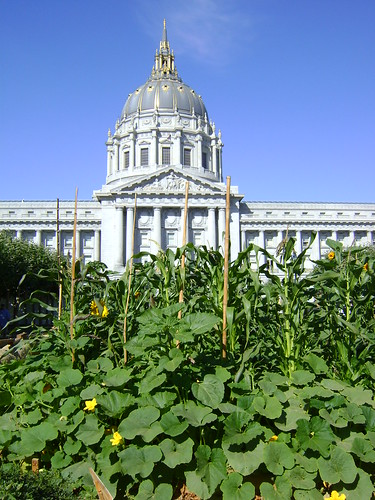
Photo: From Slow Food Nation page on Flickr

It's been nearly two weeks now since returning from Slow Food Nation in San Francisco and I haven't had a minute to digest my thoughts. The food, though, was long ago digested, pleasantly.

By now you've probably read the media (to pick just one article) and blogs (here, here, here and here) on the event, seen some of the videos of the panels, or just caught a passing reference to what went down in the city's Civic Center. It was quite a bash, crowded with people, food, and thought. I participated in a "changemakers day" session that brought non-profits, business people and farmers, many of them from California, to discuss altering the way food is grown, distributed, sold, and eaten.

Outside the auditorium and conference rooms, the action was unfolding on the plaza, with alluring aromas and a very wonderful garden. An official at the city's environment department told me that normally this was just a lawn, but repurposed into a garden, people were finally inhabiting the space. Yes, gardens are inviting. The city was considering keeping it there, if the idea could make it through bureaucratic hurdles.

There were food stands on one side of the plaza and an impromtu farmers' market on the other, with the garden inbetween. I scarfed down sausage and peppers (just shy of the requisite grease you might find in NYC), an Asian pork noodle dish, grass fed beef hot dogs, and fruit from the farm stands (one of the best peaches of the year). All of it tasty. Not frozen, packaged, or precooked, but the real deal. My only complaint was the lack of whole grains, beans or veggies. They seemed consigned to show off in the garden and farmers' market.

Another slight beef -- the pace of Slow Food. Spying a dish of hand pulled noodles, I asked someone where he had purchased it. He pointed to a stand. "We waited 60 minutes to get it, but it's very good!" he said optimistically.

Demand for this type of food, that is, good, home-made food, far exceeds the supply -- and that was evident even in these wonderful small food tents. But I feared that people unfamiliar with Slow Food would literally end up thinking that the term described the time it took to get the food rather than the values behind it. ("Oh, that's why it's called slow food!")

As for the public seminars, the ones I attended were quite good and thought provoking. The Slow Food movement is at something of a turning point, trying to redefine itself beyond the gastronomic ghetto which for too many just means rarified and expensive foods. That isn't what Slow Food is about -- it is a movement based on a political premise of good, clean, fair food -- but that political message at times gets lost in the very well-made sauce. Again, because the sauce is hand-made with love.

Eric Schlosser, the Fast Food Nation author, brought this up, when he implored the audience to recognize the workers in the fields and kitchens. Vandana Shiva, the Indian food activist, also repeatedly tried to draw the connections between what was happening in the wealthy northern hemisphere and what was happening in the poorer south. So the sentiment, the acknowledgment of the social dimension of food choices was clearly there, but it was a message brought up by “us” about “them” -- the "them" being those who did not appear at the gathering.

Could Essayist Wendell Berry’s call for a more “neighborly” approach, in which everyone in a community helps each other, widen the circle? Slow Food clearly had this issue in mind, as evident in this background essay by organizer Anya Fernald at the Slow Food Nation blog, but it still has more work to be done.

"We’re Eating Oil”

One theme that ran through the talks was the dead-end of the modern farm agro-economy. Michael Pollan, being Michael Pollan, distilled this thought by saying “we’re eating oil.”  The entire food economy has been built on cheap oil, and if that changed, so too would farming and food. Oil and natural gas are used to make the fertilizers, run the machinery and distribute food globally.

The other variable out there is global warming. Here, Wes Jackson of the Land Institute in Kansas pointed out  that the rise in temperature might not be the biggest factor in climate change. Rather, it might be the unpredictability of weather. In the Midwest, it was the rains, which right now are coming very powerfully and washing away top soil and leaching fertilizers into the Mississippi river and the Gulf of Mexico. Rain might make the Dust Bowl look tame in comparison since water is a far more powerful in pulling away soil than wind. And wind, you'll recall, picked up top soil off the prairie and darkened the midday skies of New York City in the 1930s.

Not a happy thought. But I'll leave you with this, the flip side of Slow Food that is very easy to digest. I think I might have had the best pizza I've ever eaten over at the Taste Pavilions. And ditto for the ice cream. I think the idea here is that the same values producing this food are the ones that will keep food production close at hand, working with taste and nature, and preventing the dust (or rain) bowls of the future. I'm not sure that message came with the ice cream but it was there if you took in the full circle of the experience.

- Samuel Fromartz

3 Steps Toward Sustainable Food

I wrote this piece for the premier issue of Edible Los Angeles, which debuted this summer. It's long but relevant to this weekend's Slow Food Nation celebration in San Francisco. Hope to see you there.

GardenBy Samuel Fromartz

It was fall, the weather was turning cool, and I was getting desperate. I called around, quietly looking for a dealer. Then one Sunday, I ran into Eric over at the farmers’ market in Dupont Circle.

“So, you got any good shit?”

“Sure, but you got to come get it.”

The old story. The dealer never came to you. You had to go to the dealer.

But, then again, we’re talking about a lot of shit. A pick-up full, in fact. For if my community garden plot in the city was going to perk up in the spring, if I was going to get those fist-sized Chiogga beets and tender Russian kale, I had to work a pile of well-aged manure into the ground. And yes, this would be good, mind-blowing stuff, not skanky shit in a plastic bag. It was from a real farm, with real animals that ate real grass, and then sat, like fine wine, as it mellowed. Eric had it. In fact, he had so much he was willing to give it away. As long as we could come in a truck and get it.

I felt like I was working the back channels to keep my garden going, but then it’s not easy growing your own food in the city—as so many locavores are now finding out. Still, it was well worth it, because by going local, as in six-block-local, I was completing the third step in forging a connection with my food.

Over the years, organic wasn’t enough. Local wasn’t enough. I had to get my hands dirty and grow my own.

It wasn’t as if I set out with a plan, or a program, though I now realize it’s all part of a natural progression (I won’t go so far as to say “purpose,” but maybe it’s that too) from Whole Foods to the farmers market to the garden.

The initial spark came when I found myself routinely jockeying for a parking spot in the Whole Foods parking lot. Consumers like me were clearly responding to something being sold here and I wanted to find out what it was. Sticker shock did nothing to dissuade my purchases— if anything, it enhanced them because I saw real value, not cost.

And from there, in search of ever more quality local and organic produce, I ended up at the farmers’ market and quickly became a devotee.

Looking into the evolution of my personal impulses, I saw I wasn’t alone—like others, I was responding to something in the air that morphed good food, fresh produce, organics, and the farmers’ face into a movement and an industry. That became the focus of my book, Organic Inc., but flying around the country visiting farms just whet my appetite.

Seeing so many people grow so much food in so many places made me think, “I could do this!” I signed up for a plot at a new community garden inWashington, D.C., just as I was wearily finishing my 300-plus page manuscript.

With farmers’ markets bursting with seasonal produce, you might rightfully ask, “Why even try?” I mean, local and organic seem to be everywhere. There are many reasons not to, especially in the city. I could list what’s going against you, from getting a garden plot itself (which, in one of my two locations, took 8 years), to preparing the tired soil littered with brick and concrete, to battling wire-like weeds, to engaging, in near hand-to-hand combat, the counterinsurgency of rats. Then, you must be Zen about food theft.

Plus, it takes time. I’m not a trustifarian. I’ve got a real, if self-designed, job, with too many projects, and a demanding family life, but I take the time to grow food because it feeds me in a lot of ways. In fact, I don’t even view growing food as “food production” per se but rather as a way to take my hands off the MacBook and put them in the soil, to spend precious time with my daughter, and while away the twilight hours as the cars whiz by over the nearby freeway. By doing this, you opt out of any food “system,” whether industrial, or agrarian. You become your own food system (as least so far as your veggies go).

The only downside of this ultra-local move is that it produces an ensuing syndrome, which I call Farmers Market Guilt. I depended on farmers who were my friends—who I once bought copious amounts of food from, to the tune of $50 a week—for advice to grow my own.

They willingly emailed local planting schedules and tips on beating bugs, preparing the soil, building a compost pile, growing seedlings and all the rest. In fact, their advice proved so profitable that I no longer visited them at the farmers’ market! When I admitted my guilt about that, one of my farmer friends said simply, “I’ve got a lot of other people to buy my vegetables” and left it at that. He knew most people weren’t going to get down in the dirt.

Which is okay. Because sustainability is not a series of steps, or a program or list of procedures. There’s not one way to get it right. Fred Kirschenmann, a distinguished fellow at the Leopold Center for Sustainable Agriculture at the University of Iowa, speaks of sustainability as a philosophy or consciousness. Local may be a part of that; so too organics.

And people enter the continuum at various points: whether buying a few organic food items at the supermarket, becoming a regular at farmers’ markets, or looking for a well-aged pile of shit for their garden.

What’s next? I’ve been intrigued by the way Alaska has managed its fisheries, so that there’s a plentiful and sustainable supply. Maybe it’s worth a visit up there. I’m also curious about the way oyster farms actually filter and clean seawater and provide a stellar seafood product. “Maybe we should start an oyster farm,” I said to my wife the other day as we finished up dinner. She just looked at me, as usual, amused. 

© Samuel Fromartz 2008, reproduction for personal or non-commercial use only

And the Winning Tomato Is....!

Tomato
I don’t fess-up to this very often, but being a food-writer really has its perks. This was definitely one of them. I got to squeeze, smell and taste some seriously stellar tomatoes. That big boy up top was an entry in the heaviest category at the 24th Annual Massachusetts Tomato Festival where I was judging.  (The actual winner in that category was a gnarly 3.23 pound Striped German grown by farmer Jim Ward.

I love their names almost as much as I love eating them – Black Prince, Striped Germans, Big Zak, Supersweets and Green Zebras. They sound like million-dollar racehorses, and for some local Massachusetts farmers, the bragging rights are nearly as good.

But here in New England, the weather’s been fickle. By now, we’d normally be up to our elbows in flavor packed tomatoes, but it’s been too cool and wet. Farmers I’ve spoken with say there are plenty growing on the vines, but they’re just late to ripen, or worse, are suffering cracks from too much rain. I’m just hoping that this week’s forcast of sun means I’ll be doing some canning by Sunday. If not, I’ve got a couple of recipes on the following page worth trying from Jamie Bissonnette, chef de cuisine at KO Prime here in Boston. 
Clare Leschin-Hoar

Heirlooms Romesco Sauce 
Serves 6-8
Ingredients:
1  Spanish onion, julienned
4  garlic cloves, crushed
1  red bell pepper, seeded and chopped
3  dried red jalapenos, chopped seeds intact
2 lbs heirloom tomatoes, chopped seeds and skin intact
3/4 C  Marcona almonds, toasted
1 C Spanish extra virgin olive oil
1/3 C Spanish cabernet wine vinegar
Espelette pepper to taste

Cook onions in 1 cup olive oil until translucent.  Add garlic, and cook until tender.  Add peppers, and cover with a lid.  Cook the peppers completely tender, then add the tomatoes.  Stew for 45 minute on low heat with a lid.  Add almonds, cook 10 minutes.  Puree in blender, adding the remaining olive oil. Season with Espelette and cabernet vinegar to taste.  This sauce can be served hot, cold, or room temperature. (Jamie says it’s especially good over striped bass.)

Roasted Heirloom Tomato Soup
Serves 2-4
Ingredients
10 lbs heirloom tomatoes (or plum tomatoes), cut into quarters
6  shallots, peeled and sliced thin
3  garlic cloves, peeled and crushed
2 C  chicken or vegetable stock
1 C  extra virgin olive oil
Sea salt to taste
10  basil leaves (Thai basil or regular basil)
1  fresh bay leaf
1 sprig fresh thyme

Salt the tomatoes and let sit in a deep roasting pan for 2 hours. Add remaining ingredients and cover tightly (air tight with plastic wrap then tin foil). Place pan in pre-heated 220 degree oven for 2 hours. Remove top, and puree in a blender until smooth. Pass through a chinois and season with salt as needed. Serve cold or hot

Ceder Rapids Digs Out, After the Flood

Blend pic On an extended trip to Iowa this summer, we trekked over to Cedar Rapids, Iowa, to visit longtime friend, Karen Vander Sanden. Karen also happens to be the spokeswoman for Mercy Medical Center which was evacuated during the city’s devastating June floods.

Five weeks earlier, an estimated 9.2 miles (which is roughly 1,300 city blocks) sat immersed in murky flood water when the Cedar River crested at unprecedented levels. On a sunny Sunday afternoon, we drove slowly through block after block of total wreckage, and our hearts sank with the realization of what flood victims are actually up against. It’s one thing seeing it on television. Quite another when you’re seeing it first-hand.

Different colored placards were tacked to front doors to indicate if a house was safe to enter, and while the river had receded weeks earlier, abandoned homes still sat with clotheslines that sagged with now filthy items that had been hung out to dry the day the flood hit. From the street, we could still see watermarks that stopped at rooflines and devastated lives.

Downtown was heartbreaking too. Electricity had just been restored earlier that week, but it had the feeling distinct feeling of a ghost town.

Andy Deutmeyer, chef and owner of Blend says it was a long eight-days of being shut out of his downtown restaurant. Once inside, he discovered that the water had risen to nearly five feet.

“It was a breathtaking sight. You didn’t know what to say, or where to start, or what to do. We didn’t even know how to start, so we started with the wine rack behind the bar, and after that, just started throwing stuff away,” said Deutmeyer, who hopes to reopen in October.

Fortunately, restored electricity wasn’t the only sign of recovery. An Adopt-A-Business program was launched last month, pairing hard-hit downtown businesses with companies that were less affected by the flood.

Zins, a fine dining restaurant also located downtown, was paired with RuffaloCODY, a company that specializes in fund-raising software. CEO Al Ruffalo says his company has provided Zins with access to his legal department to review their insurance polices, and to his marketing department which has been using email to update Zins’ customer base on the restaurant’s status. The company has also replaced several computers for the restaurant, and employees donated $2,000 and plenty of man-hours cleaning so construction can begin inside.

“They lost their restaurant, but on the positive side, if we do this right, their business will be better than ever,” said Ruffalo.

Karen Slaughter of the Cedar Rapids Chamber of Commerce says more than 600 businesses were damaged by the flood. While the Adopt-A-Business program can help, there’s a long waiting list for assistance. The news cycle has moved on, but they’re still accepting donations at the Job & Small Business Recovery Fund
Clare Leschin-Hoar