
ChewsWise Blog

ChewsWise Blog

GMOs Ruled Out in Africa Hunger Fight

In a significant announcement, the Alliance for a Green Revolution in Africa, backed by the Gates and Rockefeller Foundations, has ruled out the use of genetically modified crops to fight hunger and poverty on the continent, according to the group's chairman Kofi Annan, in a report in the Kenyan Business Daily.

"We in the alliance will not incorporate GMOsin our programmes. We shall work with farmers using traditional seeds known to them,” he (Annan) said. Mr Annan said poor pricing of commodities, and not type of seeds, keeps African growers away from their farmlands despite spiralling food insecurity and poverty on the continent.

“We need to get the right seeds into their hands by strengthening research partnerships with local universities and other institutions,” he said. Mr Annan said insufficient infrastructure such as roads, poor storage facilities and  weak market structures were to blame for Africa’s continued dependence on food aid.

High-yield seeds were at the center of the former Green Revolution in Asia. While many have viewed GM crops as the latest step in high-yield agriculture and a way to fight hunger in the Third World, many others have criticized that approach and African countries have resisted for numerous reasons: the risk of GMO contamination, trade impediments to GM crops, the issues of patenting seed and the high costs of large-scale intensive agriculture. Although AGRA has not ruled out GMOs, the group says on its web site:

The Alliance is not at this time funding the development of new varieties through the use of genetic engineering. We have chosen to focus on conventional breeding techniques—which can be quite technologically sophisticated—for two main reasons:

  1. We know that conventional methods of plant breeding can produce significant benefits in the near term at relatively low cost. Until now, however, conventional plant breeding has not received sufficient attention or investment in Africa, leaving untapped the inherent genetic potential available in African crops. With improved seeds produced through conventional breeding methods, plant scientists and farmers could readily raise average cereal yields from one tonne to two tonnes per hectare—making a major contribution toward ending hunger and poverty in Africa.
  2. Conventional crop breeding fits within the regulatory frameworks now in place in most African countries, enabling relatively rapid dissemination to farmers of the new varieties they desire.

In a speech last month in Cape Town, when Annan was appointed to the post, the former UN secretary-general laid out the broad goals for the initiative.

We aim to make a concrete difference in our lifetimes. With respect to seeds, the Alliance is already in the fields, working with African farmers and African agricultural scientists to breed new varieties of maize, cassava, rice, beans, sorghum and other major crops that will offer better resistance to disease and pests. Our goal is to produce 100 new crop varieties in five years. And to ensure farmers have access to these seeds, we will also move to create a wider network of local seed distributors and agro-dealers to better serve remote rural areas.

In addition, the group has goals with regards to maintaining and improving soil health, irrigation, and marketing infrastructure.

Agra was established last year with an initial $150 million grant from the Gates and Rockefeller foundations. It seeks to help millions of small-scale farmers and their families get out of poverty and hunger through sustainable growth in farm productivity and incomes. According to the Kenyan report, Annan said food production in Africa could be doubled in the next decade with improved seeds and increased access to inputs such as fertilizers and pesticides.

One More Hole in FTC Case on Whole Foods

The FTC, in making its case that Whole Foods would quash competition by buying Wild Oats, relied on Boulder, Colorado, as an example. That town, ground zero for the natural and organic foods business, is also the headquarters of Wild Oats. And in Boulder, Wild Oats had planned to open a flagship store in March but then put it off.

The FTC asserted, "The Boulder store, the leading edge of Wild Oats competitive initiative, would have opened months ago but for the proposed acquisition. Whole Foods projects that by heading off that store opening, it is avoiding more than $150,000 in lost revenues per week that would have been diverted to the new Wild Oats store in Boulder." (Emphasis added).

Well, the facts are somewhat different. The Boulder Daily Camera reports that the Wild Oats store was not delayed by the proposed acquisition, or by Whole Foods.

Wild Oats revealed this week in a court filing that it has suspended opening its Twenty Ninth Street store because of "a host of significant" design and operational problems, and not the pending acquisition by rival Whole Foods.

But the Boulder-based natural foods grocer said it still plans to open the 40,000-square-foot location feted as the company's flagship store and prototype for future expansion. It just needs to work out the kinks.

"We're still evaluating how we go to market with this store," said Sonja Tuitele, a Wild Oats spokeswoman. "How do we overcome those challenges and enhance the current design and construction of the store and make it profitable?"

The "opening of the Twenty Ninth Street store was unilaterally delayed and then suspended by Wild Oats due to a host of significant design, construction and operational problems unrelated to the pending transaction," Wild Oats' attorneys said in the filing.

- Samuel Fromartz

Consumers Hate HFCS, Survey Says

The Hartman Group market research firm announced a shift among consumers who are veering away from processed foods, sugar and specifically high fructose corn syrup, which it calls "the whipping boy of their frustration."

...When consumers do venture into the (increasingly) quiet depths of thecenter store for packaged or processed foods, they are choosing to focus their attention on those foods with the fewest ingredients, additives or preservatives. Likewise, their chief concern when reading package labels has shifted from nutrients and health claims to sugar content, where they demonstrate two complementary goals (a) reducing overall sugar intake and (b) avoiding anything with HFCS.

Choosing to re-formulate your cookie line with whole grain options is absolutely meaningless if your product still contains HFCS. Ditto for fortified juices, crackers, soups or any other packaged food category. We can guarantee you that 7UP's recent decision to market itself as "natural" to consumers fell on deaf ears when the ingredient label read "high fructose corn syrup."

In a survey, Hartman reported that 71 percent agreed with the statement, "processed foods are not good for my health." (Thirteen percent disagreed). And 89 percent agreed that "the key to long-term health is through eating more fresh foods." (Six percent disagreed). It also reported that 38 percent were swayed by  the chapter on corn in Michael Pollan's Omnivore's Dilemma. Gotcha! Just kidding on that last one.

Dovetailing with the boom in demand for corn ethanol, dare we suggest that HFCS will find itself in a death spiral? Now lets not get ahead of ourselves...

- Samuel Fromartz

A Muzzled Mackey Apologizes for Postings

"I sincerely apologize to all Whole Foods Market stakeholders for myerror in judgment in anonymously participating on online financial message boards. I am very sorry and I ask our stakeholders to please forgive me," Whole Foods CEO John Mackey said. Just last week, he tried to explain the issue by saying he was just posting for "fun."

In a sign of how seriously the company is finally taking the matter, the board also stepped up and announced it was forming an independent committee to investigate the matter. It received formal word on Monday that the Securities and Exchange Commission had launched an investigation.

Given all the issues this company has promoted - organic farming, humane animal husbandry, natural and healthy foods - it's ironic that anonymous self-promoting postings by its CEO on a message board are what has gotten the most attention.

Since the company has taken a lofty position on food and other issues, it's no wonder that any perceived ethical lapse would lead to a maelstrom of criticism. And now the company is obviously in deep damage control mode, as the SEC investigates whether any laws were broken.

Whole Foods also shut down Mackey's blog and all previous postings were briefly removed, then reposted. "... It is in the best interest of the company to temporarily hold off on posting on my Company blog. I look forward to resuming our conversations and plan on being in touch with you again soon," Mackey wrote.

Clearly, the lawyers are reviewing every utterance out of his mouth.

Can Organic Farming Feed the World?

By Samuel Fromartz

Organic food is often portrayed by its critics as a low-yielding farming method that undercuts the main goal of food production – feeding the world.

These critics also argue that if organic farming were to grow much beyond its tiny elitist niche, forests would have to be plowed under because a much greater land mass would be needed to make up for far lower crop yields.

Pretty sad picture isn't it? Organic farming is portrayed as an inferior agricultural method that ends up raping and pillaging the natural world.

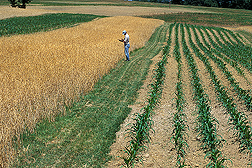
The only problem with this argument is that it doesn't square with the facts. (Nor with the actual picture if you check out the organic wheat field pictured above that was part of a USDA trial).

Although many studies have countered these arguments, three recent ones deserve notice.

First, researchers at the University of Michigan recently published a new study in the Journal of Renewable Agriculture and Food Systems that evaluated 293 studies comparing conventional and organic farming.

They found that in the developed world, such as the US, Europe and Japan, organic farming methods yielded slightly less than conventional methods.

But importantly, in the developing world, where food-scarcity is most pronounced, organic methods were actually two- to three-times as productive as conventional agriculture.

Farmers in poorer nations often could not afford the chemicals and fertilizers that are required by high-yielding seed varieties. By farming organically, they could enhance soil fertility by composting waste sources on their farms.

The researchers write that organic farming could produce enough food on a global per capita basis to sustain the current human population, and potentially an even larger population, without increasing the agricultural land base.

"My hope is that we can finally put a nail in the coffin of the idea that you can’t produce enough food through organic agriculture," said Ivette Perfecto, a professor at University of Michigan's School of Natural Resources and Environment, and a principle on the study.

She added that the idea people would go hungry if farming went organic was "ridiculous." (You can listen to a brief interview with the researcher).

Another report out of the Leopold Center for Sustainable Agriculture at the University of Iowa is also significant, for it demonstrates the long-term yield potential of organic methods.

The now nine-year-old trials "convincingly show greater yield, increased profitability, and steadily improved soil quality in organic over conventional rotations," the Leopold Center stated.

The longest running rotation of corn, followed by soybeans, oats with alfalfa, and then another crop of alfalfa, produced 188 bushels per acre of organic corn in 2006. The traditional corn-soybean rotation on conventional fields yielded 177 bushels/acre – a 6 percent deficit from the organic fields.

In soybeans, the organic fields produced 45 bushels per acre in this long rotation, compared with 43 bushels on conventional plots.

Over eight years of data, here's the average corn yield in the various methods:

  • Conventional corn, soybeans rotation, 160 bushels per acre of corn
  • Organic corn, soybean, oats mixed with alfalfa rotation, 150-1/4 bushels/acre corn
  • Organic corn, soybean, oats mixed with alfalfa, alfalfa rotation, 160-1/4 bushels/acre corn

Those include the first three years of the organic transition. If you back those years out, and only look at the organic fields post-transition you get these average yields:

  • Conventional corn, soybeans rotation, 173.2 bushels per acre corn
  • Organic corn, soybean, oats with alfalfa rotation, 162 bushels/acre corn
  • Organic corn, soybean, oats with alfalfa, alfalfa rotation, 176 bushels/acre corn

The study shows that well-managed organic crop rotations, which are key to organic farming practices, actually lead to slightly higher yields than conventional chemical methods and rotations. And in the current ethanol-infused corn boom, farmers are forgoing the traditional corn-soybean rotation and growing continuous corn on corn, which requires a greater amount of chemical fertilizers to keep the yield up.

Finally, organic farming gets criticized for its tillage practices, which critics say leads to soil erosion and leaches nitrates into groundwater. These critics say conventional "no-till" farm methods, associated with genetically modified crops and heavy doses of herbicides, are superior.

But again, the facts point to a different conclusion. USDA researchers report that organic farming methods actually produced healthier soils than no-till conventional methods.

In a nine-year study at the Henry A. Wallace Agricultural Research Center in Beltsville, Maryland, USDA researchers found that the addition of organic matter in manure and cover crops more than offset losses from tillage.

In a final three-year study, corn was grown with no-till practices on all plots to see which ones had the most productive soils. The organic plots had more carbon and nitrogen and yielded 18 percent more corn.

Needless to say, critics won't be convinced by this evidence. But then neither do those who continually assert, in the face of overwhelming evidence, that global warming doesn't exist.

We know better.

A Kenyan View of 'Food Miles'

The London Guardian has a valuable piece on the way the "food miles" debate plays out in the Third World, among Kenyan farmers who are growing organic food for British consumers. They object to a proposal by the UK's Soil Association (SA), the country's main certification body, to limit or ban imported organic food.

Starting witha debate in London tomorrow, the SA will hear views on the issue until September, when it may decide to introduce a limited or total ban. A ban would mean labelling air-freighted products so that they effectively lost their organic status due to their 'food miles'. Such a move would destroy the livelihoods of tens of thousands of smallholders across Africa in one of the continent's most enterprising export industries, forcing them back into poverty and subsistence farming.

'A ban on our export market will be death for us,' says Charles Kimani, who has put his children through school and college from the profits made from his fruit and vegetables on just seven acres of land.

Mackey v. The Man

The Wall Street Journal ran an editorial ($) on John Mackey's anonymous internet rants, following the report Friday ($) that the Securities and Exchange Commission (aka, The Man) was looking at his message board postings. In my previous post, I equated Mackey's writings under the name Rahodeb to a stupid dog trick, leading some readers to opine that I missed the gravitas of this transgression.

If Mackey wanted to really move his stock and slam Wild Oats he would not do so by engaging the day traders or whoever else populates Yahoo stock message boards. He would be sharing tofu smoothies and organic energy bars with portfolio fund managers and Wall Street analysts. They have far greater influence. The Journal writes:

The SEC is now going to unleash its army of ambitious 27-year-old lawyers to read these blog posts to see if Mr. Mackey let slip any insider information. The Federal Trade Commission is also using the posts as a PR and potential legal weapon in its campaign to block the Whole Foods acquisition of Wild Oats. The FTC, which apparently hasn't had enough to do, is alarmed that the two organic food purveyors overlap in all of 21 markets. Its gang of ambitious 27-year-old lawyers is already using Mr. Mackey's words against him to portray his takeover attempt as evidence of monopoly intent.

Without having read all of his posts, we can't say what Mr. Mackey might have disclosed. But from what we've read, we can't see how any reasonable person could conclude that Rahodeb's opinions were going to have any appreciable effect on the Whole Foods share price. The fact that they weren't was precisely the point: At a time when corporate execs are often accused of being isolated, Mr. Mackey seems to have enjoyed the Web engagement and used the semi-informed opinions voiced on a Yahoo message board as his own sounding board to sample the mood of his customers.

I agree but think the Journal reads too much into this. He wasn't sampling "the mood of his customers." He was engaging with critics or anyone else who had a bearish opinion of the company he co-founded. Why? Because he likes Whole Foods.

But here's the point. "Mr. Mackey's comments were the equal of any other. Investors who participate on such message boards know that they don't know who's on the other end of their exchanges," the Journal writes. Exactly. He was just one anonymous barking dog among many and there was no reason his bark would carry any more weight. Of course, had he signed the comments truthfully, it would have.

As for the legal issues, the Journal's news story notes:

While it isn't clear that Mr. Mackey violated any laws in his postings, they have raised numerous legal questions. The SEC is likely to examine whether Mr. Mackey's comments contradicted what the company previously said, or if they were overly optimistic about the firm's performance. In addition, the SEC will likely look at whether the CEO selectively disclosed material corporate information -- that could violate a securities law passed in 2000 known as Regulation Fair Disclosure, which was designed to prevent executives from sharing information with favored clients or analysts.

My only question is whether commenting on a Yahoo message board can be equated with dishing up financial information to "favored clients or analysts." The Race to the Bottom legal blog comments (on this and other issues):

...Regulation FD only applies to disclosure to certain types of investors or market professionals such as analysts. It really was not intended to apply to disclosure that was arguably to the entire market.  Disclosure in the Yahoo forum is arguably to the entire market (and, in any event, would arguably meet the definition of "public dislcosure" for purposes of Regulation FD).   

- Samuel Fromartz

Who is Rahodeb?

"Like Whole Foods itself, Mr. Mackey, a 53-year-old vegan, is somewhat unconventional."
- The Wall Street Journal

Turns out John Mackey, the CEO of Whole Foods, is like a lot of Internet trolls, posting for years on message boards under a pseudonym. Writing as Rahodeb (an anagram of his wife's name, Deborah) on Yahoo, he dissed Wild Oats, the company he's now trying to buy, and praised Whole Foods and even his own haircut.

His posting penchant was revealed in a document (pdf) unsealed by the Federal Trade Commission Tuesday night and reported in the Wall Street Journal ($), which googled his handle to find out what he wrote. Mackey explains on Whole Food's Web site:

I posted on Yahoo! under a pseudonym because I had fun doing it. Many people post on bulletin boards using pseudonyms.

I never intended any of those postings to be identified with me.

The views articulated by rahodeb sometimes represent what I actually believed and sometimes they didn't. Sometimes I simply played 'devil's advocate' for the sheer fun of arguing. Anyone who knows me realizes that I frequently do this in person, too.

The CEO-as-playful trickster is rather unusual in the annals of corporate America, but not at Whole Foods Market. The rivalry between WFM and Wild Oats was legion in the natural food business and was reflected in the comments Mackey made under the pseudonym. That Mackey thought Wild Oats was mismanaged and performing poorly was not a secret.

What was unusual is that Mackey felt compelled to state this opinion on a stock message board for "fun." CEOs aren't supposed to sound like day traders, but then Mackey has never followed the CEO's play book. He's a classic entrepreneur. He shoots from the hip. He sometimes misfires. So far, he hasn't had any fatal financial blow-ups (the biggest, in my estimation, was the company's failed foray into the Internet but no one remembers that).

As CEO transgressions go, this doesn't really rate with falsifying accounting books, managing quarterly earnings estimates, backdating stock options, lobbying Congress for tax breaks, seeking back-door regulatory relief, discriminating against women or minorities, or even sleeping with interns. It's more in the category of a stupid dog trick. CEOs usually pump up their companies and slam the competition with more circumspect language and Power Point presentations in front of Wall Street analysts.   

What these antics exemplify are aspects of Mackey's personality - that he is highly competitive and enjoys sparing with opponents, even if anonymously, and likes to promote the company he co-founded. This isn't very CEOish, but then he didn't learn his game at Harvard Business School. Which is one reason he lands in the media so often. Presumably, his competitive juices will be sated, at least somewhat, by this antitrust battle with the FTC.

- Samuel Fromartz