

ChewsWise Blog

ChewsWise Blog

Who is Rahodeb?

"Like Whole Foods itself, Mr. Mackey, a 53-year-old vegan, is somewhat unconventional."
- The Wall Street Journal

Turns out John Mackey, the CEO of Whole Foods, is like a lot of Internet trolls, posting for years on message boards under a pseudonym. Writing as Rahodeb (an anagram of his wife's name, Deborah) on Yahoo, he dissed Wild Oats, the company he's now trying to buy, and praised Whole Foods and even his own haircut.

His posting penchant was revealed in a document (pdf) unsealed by the Federal Trade Commission Tuesday night and reported in the Wall Street Journal ($), which googled his handle to find out what he wrote. Mackey explains on Whole Food's Web site:

I posted on Yahoo! under a pseudonym because I had fun doing it. Many people post on bulletin boards using pseudonyms.

I never intended any of those postings to be identified with me.

The views articulated by rahodeb sometimes represent what I actually believed and sometimes they didn't. Sometimes I simply played 'devil's advocate' for the sheer fun of arguing. Anyone who knows me realizes that I frequently do this in person, too.

The CEO-as-playful trickster is rather unusual in the annals of corporate America, but not at Whole Foods Market. The rivalry between WFM and Wild Oats was legion in the natural food business and was reflected in the comments Mackey made under the pseudonym. That Mackey thought Wild Oats was mismanaged and performing poorly was not a secret.

What was unusual is that Mackey felt compelled to state this opinion on a stock message board for "fun." CEOs aren't supposed to sound like day traders, but then Mackey has never followed the CEO's play book. He's a classic entrepreneur. He shoots from the hip. He sometimes misfires. So far, he hasn't had any fatal financial blow-ups (the biggest, in my estimation, was the company's failed foray into the Internet but no one remembers that).

As CEO transgressions go, this doesn't really rate with falsifying accounting books, managing quarterly earnings estimates, backdating stock options, lobbying Congress for tax breaks, seeking back-door regulatory relief, discriminating against women or minorities, or even sleeping with interns. It's more in the category of a stupid dog trick. CEOs usually pump up their companies and slam the competition with more circumspect language and Power Point presentations in front of Wall Street analysts.   

What these antics exemplify are aspects of Mackey's personality - that he is highly competitive and enjoys sparing with opponents, even if anonymously, and likes to promote the company he co-founded. This isn't very CEOish, but then he didn't learn his game at Harvard Business School. Which is one reason he lands in the media so often. Presumably, his competitive juices will be sated, at least somewhat, by this antitrust battle with the FTC.

- Samuel Fromartz

Boom Underway in GE Corn

By Lisa M. Hamilton

The numbers are in, and as predicted back during spring's corn-planting frenzy, it seems that the ethanol boom has been a boon for genetically engineered corn.


Photo: Nature.com

On July 5th the USDA's Economic Research Service released the 2007 stats on the adoption of genetically engineered varieties in corn, cotton and soybeans. Of all the corn planted this year in the US, 73 percent was GE--that's compared to only 25 percent of the crop in 2000. Of course, adoption has been increasing steadily over the past seven years, averaging increases of 6 percent each year, but this year the graph spiked upward by 12 percent over 2006's crop. And that's the average. In the Plains, the numbers were even higher: South Dakota led the country with 93 percent of its crop in genetically modified varieties, followed by North Dakota with 88 percent and Kansas with 82 percent. 

Because of the ethanol boom, farmers planted 19 percent more corn than last year. The GE portion--at 73 percent of the entire crop--amounts to 67,817,000 acres, or slightly less than the combined land mass of Illinois and Iowa. Within that space are approximately 2 trillion genetically engineered corn plants.

Numbers of this magnitude are hard to grasp. What's not hard to see, however, is the profit--and power--this grants to those behind ag biotech. By this I mean not corn farmers, many of whom are now struggling through drought, but rather Monsanto and like corporations--the true beneficiaries of agricultural biotechnology, which sell seed and chemicals. In its third quarter earnings report, Monsanto reported record sales of $2.8 billion, 23 percent higher than a year ago, reflecting the boom in GE seeds and herbicides. Earnings jumped 71 percent.

"Strong customer demand for ... branded corn seed products contributed to a sixth consecutive year of market share gains in the U.S. corn seed market," the company said. "The increase could be as large as 4 or 5 percentage points, pending final returns, which would be the largest historical one-year gain for Monsanto brands in the corn seed market."

Monsanto's board just approved $610 million to expand its U.S. corn production facilities over the next three years - which means that this year's record corn crop is likely to be eclipsed in the near future.

A More Nutritious Organic Tomato?

A recent study comparing organic and conventional tomatoes found that the organic tomatoes have higher levels of flavonoids - an antioxident - but does this mean the tomatoes are "healthier"?
The researcher at the University of California Davis behind the study said the results were intriguing but not definitive. "There's a lot of confusion," said Alyson Mitchell, a professor of food chemistry and toxicology at the University of California, Davis, in this Sacramento Bee article. "For every study that shows there's a difference, there's another that shows there isn't."

Interestingly, this study took a long-term look at two particular flavonoids - quercetin and kaempferol - and found on average they were 79% and 97% higher, respectively, in organic tomatoes than conventional ones. 

Scientists theorize that "flavonoids are produced as a defense mechanism that can be triggered by nutrient deficiency, such as a lack of nitrogen in the soil," the BBC reports. Organic farms add compost to the soil to build fertility, rather than fast-acting synthetic nitrogen.

A previous study by Mitchell et al in 2003 found that organic berries contain higher levels of phenolics, which include vitamin C and antioxidents. They theorized then that plants developed these compounds in the absence of chemical fertilizers as a way to combat pests, diseases and natural stresses that may be present at higher levels on organic farms.

This new study may also support findings by the University of Texas, which found a long-term decline in certain nutritious elements in conventionally grown fruit and vegetables. The researchers theorized that this too reflected the increasing use of synthetic chemical fertilizers over a half-century - a theory that researchers around the world are pursuing, according to a San Francisco Chronicle report last year.

What's less clear is whether these nutritional differences are significant to human health. They should also not obscure a bigger point: that consuming a healthy amount of fruits and veggies each day is more important than eating too little or none at all.

- Samuel Fromartz

A Look Inside Whole Foods in London

The Financial Times had one of the more insightful reports on the new, 80,000 square foot Whole Foods store in London. Two things stand out: first, that such a large proportion of the store is devoted to casual restaurant dining, and secondly, that it is selling a lot of prepared food.

Whole Foods already sells a far higher proportion of perishables (meat, produce, dairy, prepared foods) than most supermarkets - a characteristic that led the FTC in part to deem it a monopoly. But now it is moving further into prepared and eat-in meals. Is the supermarket morphing into a restaurant? Not exactly, as the article points out. Rather, Whole Foods is finding that supermarket and dining sales complement each other. What the article doesn't mention is that perishables, prepared food and restaurant meals also have higher profit margins than grocery items.

You see this trend of eat-in dining in stores such as Wegmans in the East, which Whole Foods cites as a major competitor. Their profits on this business might also explain why Wegmans can offer good prices on their grocery items. I also witnessed the trend at work at a Whole Foods in Alexandria, south of Washington. The prepared foods section was the busiest in the store at 7 p.m., and customers were eating their dinners in the booths by the front of the store. Many people had kids with them. Why? Because it's a fast meal but not fast food. You could still get an enormous range of salads, grains, beans, tofu, veggies and fruit to go with your pizza, roast turkey or prime rib.

As for whether this approach makes Whole Foods a monopoly, the FT had this interesting quote:

“They are definitely going to up the ante for consumers,” said one (observer). “I think the major British supermarkets have become complacent over the past few years and have become takers rather than givers on the back of the growing interest in organic food. That approach is going to have to change now.”

In other words, innovation don't stifle competition in the supermarket industry, it enhances it ... and consumers win.

How the Media Missed the Organic Story

By Samuel Fromartz

The USDA's recent approval of 38 non-organic ingredients in organic food products was widely portrayed in media reports as evidence that the USDA was watering down organic standards.

This is a standard interpretation - that, at the behest of agribusiness, the USDA is constantly chipping away at the integrity of organic food regulations, making it easier for big companies to subvert what organic food is all about. They were doing so now by including these 38 non-organic ingredients in organic food.

The only problem was this was flat out wrong.

Why? First, because the USDA has no statutory authority over these non-organic ingredients. The body that oversees the so-called National List of these ingredients - and which stands as the final arbiter of what goes into organic food products - is a citizens advisory panel known as the National Organic Standards Board.

As section 6157 of the Organic Foods Production Act of 1990, which governs organic food, makes clear:

The National List established by the Secretary shall be based upon a proposed national list or proposed amendments to the National List developed by the National Organic Standards Board.

The Secretary may not include exemptions for the use of specific synthetic substances in the National List other than those exemptions contained in the Proposed National List or Proposed Amendments to the National List.

In other words, not even the Secretary of Agriculture can overrule the decisions of the NOSB with regards to what goes on this list. This was explicitly written into the law by Sen. Patrick Leahy in 1990 precisely to prevent the list from being controlled by the USDA (a point I explain more fully in my book).

So who sits on the NOSB? It is made up of certifiers, farmers, retailers, scientists, and food processors, including big and small companies and those with no industry affiliation at all. Now you can argue about the composition of the NOSB but it would be a gross misrepresentation to say the members are interested in watering down and subverting organic food regulations. If they were, we should all stop buying organic food now. But they aren't, so we shouldn't.

There have also been instances where the USDA has re-interpreted or put forth new regulations, leading to a political backlash from organic advocates that forced the department to reverse course. This was not what happened here, however.

Secondly, the approval of the 38 ingredients was actually a dramatic tightening of organic food regulations that resulted from a law suit brought by a small organic blueberry farmer from Maine, named Arthur Harvey. But I saw no headlines screaming, "Organic Food Regulations Tightened! Numerous Non-Organic Ingredients Disallowed."

In a recent public email, Jim Riddle, who trains organic certifiers and was one of NOSB's more outspoken (and radical) members during his tenure as chairman, explains:

I received a call from a reporter, informing me that 38 non-organic ingredients had been approved by USDA to be added to the National List. He did not mention that the USDA had approved the substances in an Interim Final Rule, which allows for 60 days of public comment. Since returning home, I have become aware of heated rhetoric on this issue, with charges of “Sneak Attack”, “Undermining the Organic Standard”, etc. I would like to say a few words to put this issue into perspective.

Previous to the Harvey ruling, (which became final on June 9, 2007), certifiers had allowed processors to use non-organic ingredients in up to 5% of an “organic” product, (which must contain at least 95% organic ingredients), if the processor could demonstrate a good faith, but unsuccessful, effort to source the ingredient(s) from organic sources. Hundreds, if not thousands, of non-organic ingredients had been allowed.

If all 38 minor ingredients are added to the National List, it will bring to 43 the number of non-organic ingredients that can be used in “organic” products, if the manufacturer can demonstrate to the certifier that organic forms are not commercially available. This is a significant narrowing from the previous, pre-Harvey situation. (emphasis added)

While I have serious concerns with a few of the petitioned items, including hops, fish oil, and “natural” casings ... I urge my colleagues to direct your concerns to the USDA. To exaggerate and/or misrepresent this issue in the press weakens confidence in organic foods, harms organic farmers, and undermines the growth of this ecologically-sound production system.

The only thing I would add to Riddle's comment is that every ingredient must be reviewed by the NOSB before it gets on the National List. There's rarely 100-percent agreement on these items, only consensus, reflected in votes by the NOSB. (You can read the transcripts of meetings at the NOSB's web site if you have a few hours. They are actually very informative. Or better yet, attend one of their public meetings). Now is the opportunity to comment, if you oppose any or all of the 38 items, though I think it doubtful that the USDA will force the NOSB to reconsider the matter.

Where the media erred was in trying to find evidence to fit the premise that organic regulations were being loosened. Had they looked more deeply into the matter they might have realized that the evidence led to an entirely different conclusion.

Is "Green" the New "Natural"?

The explosion of the green marketplace in the past year has been stunning, but it turns out it's not really clear what "green" means. A recent New York Times piece on Home Depot reports:

“Everybody is in a mad scramble to say how green they are,” said Jim O’Donnell, manager of the Sierra Club Stock Fund, which handles $50 million in a portfolio of companies it considers environmentally friendly. He added that he was hopeful the product greening would become more meaningful over time.

One reason for the scramble is that there are few verifiable or certified standards to substantiate claims. Crest has introduced a toothpaste containing green tea extract and natural mint, sold under the “Nature’s Expressions” label, even though it contains artificial ingredients like most toothpastes. Raid sells a wasp and hornet killer in a green can marked “Green Options” with “Natural Clove Scent.”

“You almost have to be a scientist with a lab to decipher the dizzying array of claims,” said Robyn Griggs Lawrence, editor in chief for Natural Home magazine. “It’s hard to get information on what makes a product green.” (Emphasis added)

The food business went though a similar progression, with the term "natural." The term was slapped on just about every product and only regulated by the USDA in one specific arena - meat. The word "natural" in meat means "minimally processed" and without colorings or additives, so virtually any meat product could qualify. Looking for beef produced without antibiotics or synthetic hormones? The word "natural" does not identify such a product.

Organic food proponents saw what happened to the word "natural" and decided they wanted more rigor for the word "organic," so set up a system of verifiable claims that ensured the word had integrity. Hence, the national regulations for organic food.

As for the word "natural," the Hartman Group market research firm reports it is now virtually meaningless. "In fact, the word has become so diluted that many actively avoid products bearing this word out of fear that they could be 'imposters,'" the firm says.

Which only leads one to wonder about the fate of the word "green."

Organic Call To Action on Farm Bill

By Samuel Fromartz

Every so often, the broad coalition of organic food supporters – which include food companies, retailers, farmers, advocacy groups, and of course consumers – coalesce around one crucial issue.

This happened in 1997, when the first draft of organic regulations were released by the USDA and included such anti-organic practices as irradiation, genetically modified crops and sewage sludge fertilizer. The community sent an unprecedented number of comments to the USDA opposing the so-called "Big Three" and they were struck down in the final version of regulations.

In 2003, when a Georgia Congressman inserted a rider onto a bill in the dead of night and won passage for the right to use non-organic animal feed (sought by one of his chicken processors), the community rose up again. Led by opponents in Congress, the measure was rescinded in a subsequent bill.

Now, arguably, it's time again for the organic community to rise up again, spreading the word through advocacy groups, in email, on blogs and most potently, at the check-out counters of natural food stores and co-ops.

What's the issue this time around?

  The Farm Bill. Organic supporters have been pushing very hard in Congress to win a few crucial programs for organic farmers but the buzz is at a low level in Washington. Organic doesn't even win a mention as a worthwhile alternative (evident in this recent Washington Post editorial),  when the talk comes to reforming the farm bill.

What are supporters of organic farming seeking?

  • Basic research funds. Currently organic farming research and education gets about $13 million from a patchwork of USDA programs. But only $3 million of those funds is specifically dedicated for organic farming. Supporters want to increase those targeted funds to $15 million annually in mandatory funding - this, out of a USDA research budget of about $2 billion.
  • Certification cost share. Farmers can get up to $500 annually to offset up to 75 percent of the costs of organic certification. (This is the only "subsidy" specifically targeted to organic farmers and is meant for smaller farmers). But many states have run out of money and they won’t get any more until the new farm bill is approved. Supporters are looking to increase the cost share to $750 through $25 million in funding over five years.
  • Crop insurance. Organic farmers must pay a 5 percent premium to receive crop insurance but their crop losses are compensated at the same rate as conventional growers (even though the organic crop is worth more). They want the USDA to correct this unfair practice.
  • Transition Support. Transitioning farmers must follow organic methods for three years before they can sell their crops under the organic label. That means their costs are usually higher but they are still getting paid conventional prices for their crops. The lobby is looking for $50 million per year to help with the transition process, with the funds split between technical and financial assistance.
  • Data Collection. Right now there is little reliable data on organic products, on the amount and sources of organic food imports, on the prices farmers get for their crops or the usual information available to conventional farmers. That discourages investment, skews crop insurance decisions and undermines the market. So supporters wants some dedicated funds for this type of research.  (For more detail on  these issues, see this PDF from the Organic Farming Research Foundation).

Although the House Agriculture Committee nodded in the direction of organic farming in the mark up of the farm bill, much of the funding under consideration would be discretionary – not mandatory. The programs will only get funded if money can be found, which is highly unlikely in this tight fiscal climate.

Why does organic farming need these funds?

Demand for organic food now exceeds supply, but US farmers are not converting fast enough to fill the gap. The costs of transition, the lack of knowledge about organic methods, and uncertainty about the market all play a role in inhibiting conventional farmers from making the switch. With American farmers lagging, production is increasingly shifting overseas – meaning U.S. farmers will lose out on a lucrative market. Consumers will see more organic products from Mexico, China, Chile, Brazil, India, Australia, Italy and Turkey, including fresh and frozen produce, soybeans, grass-fed meat, grains and beans. That's not a bad thing, in terms of agricultural practices and opportunities in those countries, but it won't do anything for farming in the US.

So what can we do?

The Environmental Working Group has launched a worthwhile site to generate 30,000 signatures to lawmakers by July 15. But for mass action, retailers and co-ops with direct access to consumers need to step up to the plate. They need to publicize this issue at the check-out counter, since most people don't even know about it. The message: Support organic farmers in the 2007 Farm Bill.

The point is to win baseline funding for organic agriculture, so that it can be increased in the next farm bill. If the baseline is near zero, it isn't going to move at all – not in the next bill, or the one after that and farmers will continue to sit on the sidelines.

When you wonder why so many organic products are originating overseas, you will have your answer: the modest government incentives and research U.S. farmers needed to pursue organic farming weren’t available. So they didn't bother to switch.

Big Decertified Dairy Pulls Out of Organic

By Samuel Fromartz

 
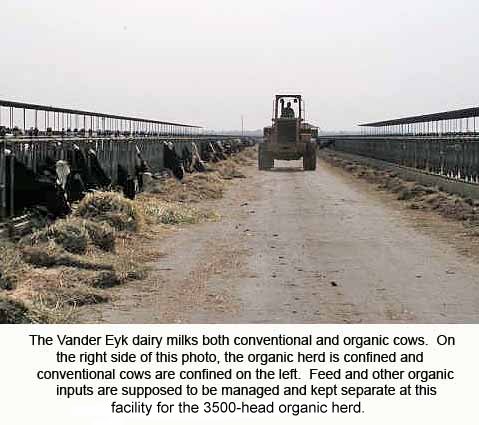
The Case Vander Eyk Dairy, which reportedly said it was seeking recertification of its 3,500 head organic herd, has decided not to pursue it after all.

The controversial dairy in the Central Valley of California had been certified by Quality Assurance International, but QAI suspended the company's organic dairy operations in May for failing to meet regulatory standards. The dairy then approached California Certified Organic Farmers about beginning the recertification process.

Photo and caption: Cornucopia Insitute

Peggy Miars, executive director of CCOF, one of the oldest organic certification agencies in the nation, said in an email the dairy was in "the initial review stage" for recertification. "Obviously, CCOF holds all applicants to the same strict standards and would ensure that all previous noncompliance issues are resolved."

"However, that seems to be a moot point based on my conversation with our contact at Vander Eyk," Miars continued. "He said that the Vander Eyk family is pulling out of the organic dairy business indefinitely."

Vander Eyk plans on getting CCOF to recertify its pasture as organic but run the dairy as a conventional operation. Presumably, this would give Vander Eyk flexibility to return to organic in the future, since a farm must prove that its pasture was farmed organically for three years before it can win certification. Certifying a conventional dairy herd as organic, however, only takes one year.

The farm had what was known as a "split operation," with 10,000 organic and conventional cows. The operation had been criticized by the Cornucopia Institute, among others, for minimizing pasture on its farm.

To recertify its pasture, it will have to submit a "farm plan" that lays out its organic practices in detail, correct any non-compliance issues, pass certification inspections, and be reviewed by the USDA.


Chilean Salmon Juggernaught

Chilean farmed salmon has increased more than 10-fold in thepast 15 years, but it is not without problems. The World Wildlife Fund reports that the production is taking a toll on the nation's inland lakes, where salmon smolts, or juvenile fish, are produced. Oxygen-free dead zones in the lakes are growing, fish are escaping and invading rivers and lakes and pollution is mounting. WWF estimates that switching production to contained ponds would would cost around $43 million -- just 2 percent of the money the country makes from salmon exports each year. This is just one of the criticisms of farmed salmon, which also rely heavily on stocks of wild fish to feed salmon, depleting wild species.